Key Takeaways
- Optimize Flow: Reduce travel distances, eliminate bottlenecks, and improve traffic patterns to boost productivity and lower operating costs in your warehouse.
- Balance Space & Access: Maximize storage density with strategic aisle widths while maintaining safe, efficient equipment movement.
- Match Equipment to Layout: Select forklifts and material handling equipment designed for your aisle dimensions to improve performance and safety.
- Prioritize Safety: Separate pedestrian and equipment paths, improve visibility, and design layouts that reduce collision and product damage risks.
- Plan for Growth: Create flexible warehouse layouts that can adapt to changing inventory, throughput demands, and future expansion without major redesigns.
Warehouse efficiency starts with one critical factor: layout design. From aisle width to equipment selection, every decision within your facility directly impacts productivity, safety, and overall operational performance.
At LiftOne, we partner with businesses to evaluate how their warehouse layout supports daily operations; helping identify opportunities to improve flow, increase storage capacity, and reduce inefficiencies. By aligning layout strategy with the right equipment and processes, organizations can create a more controlled and productive environment.
Why Warehouse Layout Is So Important
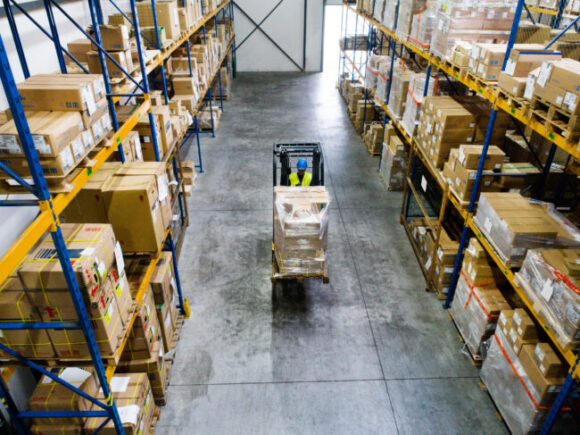
A well-designed warehouse layout does more than simply organize inventory – it defines how effectively material moves from receiving to storage to outbound shipping. Every step in this process affects throughput, labor efficiency, and safety.
An inefficient layout can create:
- Congested aisles and workflow bottlenecks
- Increased risk of collisions or product damage
- Longer travel times for operators and equipment
- Underutilized storage space
Over time, these challenges can significantly impact operational costs and performance. In contrast, an optimized warehouse layout improves flow, reduces unnecessary movement, and creates a safer environment for both operators and pedestrians.
At LiftOne, we help customers evaluate how their current layout is performing – and where adjustments can lead to measurable improvements.
Core Principles of an Efficient Warehouse Layout
While each facility has unique requirements, efficient warehouse layouts typically follow a set of proven principles designed to support productivity and safety.
These include:
- Minimizing travel distance: Reducing the amount of movement required to store or retrieve products improves efficiency and lowers labor costs
- Maximizing usable storage space: Strategic use of vertical space and aisle configuration increases capacity without expanding the facility. A well-optimized layout can also help right-size a facility altogether, avoiding unnecessary square footage and reducing real estate and operating costs
- Creating clear traffic flow: Separating pedestrian walkways and equipment lanes helps reduce risk and improve visibility
- Matching equipment to application: Using the right type of forklift for your layout ensures safe operation and optimal performance
- Designing for flexibility and growth: Layouts should allow for changes in inventory mix, volume, and future expansion
LiftOne works closely with customers to apply these principles in real-world environments—ensuring layout decisions support both immediate needs and long-term goals.
Choosing the Right Equipment for the Right Aisle
One of the most important—and often overlooked—elements of warehouse design is aisle width and how it aligns with the equipment operating within the space.
Different equipment types are engineered to operate within specific aisle widths. Narrower aisles can significantly increase storage density, but they require equipment designed for precision and maneuverability.
For example:
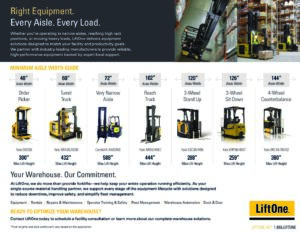
- Very narrow aisle equipment (like turret trucks) allows operations to maximize vertical storage while reducing aisle space — typically operating in aisles as narrow as 60” – 70”, depending on the model
- Reach trucks strike a balance between storage density and flexibility — generally requiring around 102” of aisle width
- Order pickers support efficient picking operations in tighter configurations — some models operate in aisles as narrow as 48”
- Counterbalance forklifts require wider aisles but offer versatility for multiple applications — typically 120” – 144” depending on the configuration
- Articulating trucks combine the reach of a counterbalance forklift with the aisle efficiency of a reach truck, operating in aisles as narrow as 66’ (5’6”), making them ideal for facilities that want to increase storage density without a full very narrow aisle setup
The key is finding the right balance between space utilization and operational efficiency.
At LiftOne, we help customers assess how aisle width, rack configuration, and equipment selection work together—ensuring operations remain productive without compromising safety. Choosing the right combination can lead to better throughput, reduced product damage, and improved overall workflow.
|
Partnering with LiftOne for Smarter Warehouse Design
Designing an efficient warehouse layout is not just about spacing—it’s about creating an environment where people, equipment, and processes work together seamlessly.
At LiftOne, we take a consultative approach by helping customers:
- Evaluate current warehouse layouts and workflows
- Identify opportunities to improve storage density and efficiency
- Align equipment selection with operational requirements
- Optimize aisle width and traffic flow for safety and productivity
Our goal is to help customers create practical, scalable solutions that support long-term performance—not just short-term improvements.
Optimizing Your Warehouse for the Future
As warehouse demands continue to evolve, layout efficiency becomes even more critical. Increased throughput expectations, labor constraints, and safety requirements all place greater pressure on facility design.
By taking a strategic approach to layout and aisle width—and leveraging the right equipment and expertise—businesses can create more resilient, efficient operations.
Contact LiftOne to schedule a warehouse consultation and discover how your layout can be optimized for improved efficiency, safety, and long-term performance.